
There’s a lot of drama around AI at the moment.
Will it replace jobs or even humans? Will it change how we work? Are we all going to have AI agents attending meetings while we sit at home drinking coffee? 😆
For the immediate future, allow me to suggest something far more useful.
Use AI to make yourself more articulate, successful and happy.
When it comes to presenting, AI can be an incredibly useful thinking partner. It can help you develop ideas, find better ways to express them and add creativity to your presentation.
But there’s a catch – you still need to know what good looks like.
After decades teaching presentation skills training, I’ve seen that the best presenters understand their audience, know what they want to achieve and can recognise when a message is going to cut through. That human horsepower becomes even more important when AI enters the picture.
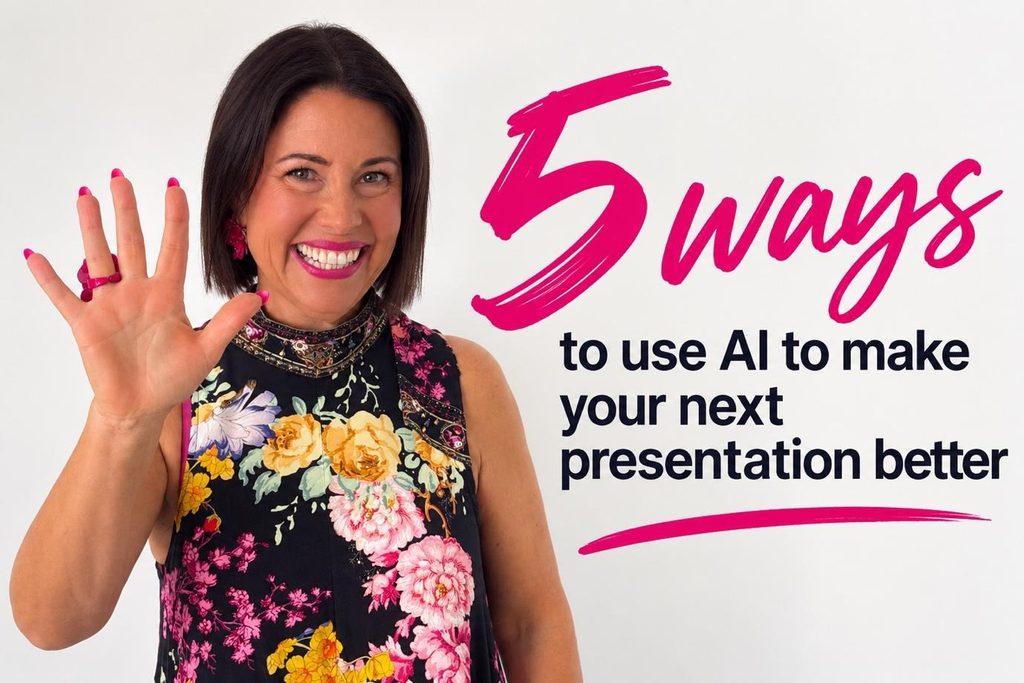
So, before you ask AI to build 47 slides with matching icons (cringe), try these five ideas instead.
1. Find your key message before you open PowerPoint
One of the biggest mistakes people make is opening their slide software before they’ve worked out what they actually want to say.
Instead, please start with your message and ask: what is the ONE thing I want my audience to remember when they leave?
AI can help you articulate that message. Tell it who your audience is, what you’re presenting about, what you want them to think, feel or do, and ask it to suggest possible key messages.
Then use your human judgement. Interrogate the output. Challenge it. Ask for something shorter, stronger, clearer or more memorable. Keep going until you read the sentence and think, YES! That’s it!
This is one of the ways I encourage people to think differently about AI in a presentation skills course. AI can generate quickly. Your expertise determines whether the result is worth saying.
2. Create a cracking icebreaker
Once you’re clear about your audience and what you both need to achieve, ask AI to help you find an engaging way to open.
And when I say icebreaker, I don’t mean one of those annoying games where a trainer makes you reveal your spirit animal to the person sitting next to you!
Your icebreaker is your hook: maybe it’s a surprising statistic, a fun fact or the beginning of a relevant story.
Give AI plenty of context and ask for options. Then choose the one that best suits your personality, your audience and the occasion.
Whether I’m delivering public presentation skills training in Sydney, or working with people inside organisations, I see the same issue regularly: presenters waste the opening moments on housekeeping and background information.
Your audience is deciding very quickly whether you’re worth listening to.
Give them a reason to lean in.
3. Weave a metaphor through your presentation
Here’s where AI can be great fun.
Once you have designed your script, give it to AI and ask for a metaphor that could run through the presentation.
Perhaps your message could be compared to building a bridge, navigating a journey, solving a puzzle or something completely unexpected.
Introduce the metaphor near the beginning. Bring it back at relevant moments throughout your presentation. Then return to it at the end.
A good metaphor gives your audience something concrete to attach your ideas to, particularly when the subject matter is complex.
This is the kind of technique we explore in my presentation skills course in Sydney.
4. Ask AI to suggest a prop
Props are seriously underused in business presentations.
Give AI your script and ask: “What physical object could I use to make this idea easier to understand or remember?”
You might hold something up, demonstrate something with it or pass it around the room.
Ask for lots of ideas because the first suggestion may be completely ridiculous!
The people attending my presentation courses in Sydney often discover that a simple visual moment can communicate an idea far more effectively than adding another slide.
If you’re exploring presentation training, start noticing what happens when a presenter gives you something unexpected to look at. Your attention comes straight back to them.
5. Finish with a fabulous closing line
Please don’t finish a great presentation with: “So… yeah… I think that’s everything. Any questions?”
You can do better!
AI is excellent at generating short closing statements that connect back to your opening icebreaker.
Give it your script and opening, then ask for ten possible closing lines. Keep refining until you find one that sounds like YOU.
A strong close creates that satisfying feeling that the presentation has come full circle and does not include a call to action – that should come earlier. The job of the close is to help your audience know that the message is complete.
This is something worth practising whether you’re looking at presentation training in Sydney, public presentation training courses or simply preparing for your next important meeting.
AI still needs your human horsepower
AI gives presenters access to extraordinary creative support.
Use it. Play with it. Ask better questions. Challenge its answers and keep refining.
The more you understand about persuasive presenting, the better you’ll become at recognising which AI-generated ideas will work for your audience.
And that’s a pretty exciting combination.
If you’d like to develop your presentation and persuasion skills with me, you can find upcoming presentation skills courses and training dates in Sydney and other Australian locations here:
Michelle Bowden Persuasive Presentation Skills Training Dates:
https://michellebowden.com.au/presentation-skills-training-dates/
Michelle Bowden CSP is an award-winning presentation skills training expert, keynote speaker and bestselling author of How to Present. For 30 years, she has helped professionals become confident, compelling and persuasive presenters through practical presentation skills courses, executive coaching and corporate training across Australia. www.michellebowden.com.au
About the Author


